Wednesday, January 27, 2010

"...Like a Diamond in the Sky"


I remember looking up at the sky when I was a kid and had no idea what the thousands of dots in the sky were. They looked like tiny pin pricks which showed bits of some holy daylight from beyond the otherwise dark night sky. And that was probably the beginning of a four-year old’s fascination for the night sky; the thousands of bright pinpricks –the twinkling little stars. For all of you out there, who feel or have felt even the tiniest of inklings of awe and wonder for the vast dark night sky at some point of time; I’m sure you have your own story to tell.

Throughout man’s existence on the planet, since the time of the early Neanderthal man, he has tried to explain what the sky, the pinpricks meant; what they implied. We had our share of men –astronomers and physicists who strived to solve the mysterious unexplained, right above them in the sky.

“Where does it come from? This quest, this need to solve life's mysteries, of the simplest of questions can never be answered. Perhaps we'd be better not looking at all, not delving, and not yearning. But that's not human nature, not the human heart. That is not why we are here.”

We will keep looking. We will keep searching for answers. We will always be awed by the mahakaash. We will keep looking at the constellations, the stars, the planets, the nebulae, the thousands of pinpricks and wonder. And be amazed now, tomorrow, for many many years to come.

***

Men came and went. Theories came and went. Models of the Universe explaining why the night sky is the way it is, were given. Few of them accepted. Even they went. The only thing that stayed the way it was, was the sky and man’s fascination for the unexplained.

For the thousands of bright pinpricks in the sky...


-Pramit

Saturday, January 9, 2010

Annular Solar Eclipse-January 15th 2010


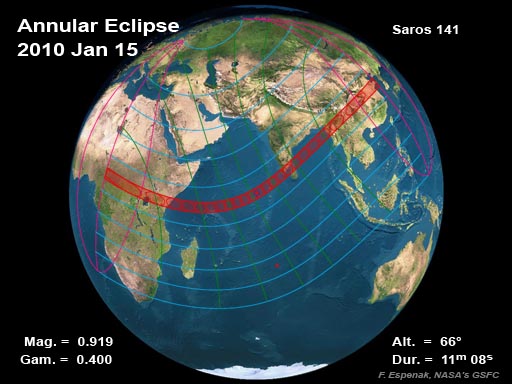
On Friday, 2010 January 15, an annular eclipse of the Sun is visible from within a 300-km-wide track that traverses half of Earth. The path of the Moon's antumbral shadow begins in Africa and passes through Chad, Central African Republic, Democratic Republic of the Congo, Uganda, Kenya, and Somalia. After leaving Africa, the path crosses the Indian Ocean where the maximum duration of annularity reaches 11 min 08 s. The central path then continues into Asia through Bangladesh, India, Burma (Myanmar), and China. A partial eclipse is seen within the much broader path of the Moon's penumbral shadow, which includes eastern Europe, most of Africa, Asia, and Indonesia.

* courtesy NASA
to view the official page,

Sunday, March 29, 2009

Distance to Sun ???

Now that I recall there is certainly a need to educate people on Astronomy, atleast the basics since this Friday on 27th March during Astro Quiz one of the participants asked me how many light years away is the sun from earth?
I was speechless....


-Bhaskar

Celebrating International Year of Astronomy !!!


Certainly declaration of 2009 as International Year of Astronomy has sparked a new interest in Astronomy and those wary of the sciences will definitely be attracted once again to this mighty realm. With this in mind, we @ Astronomy Club are organizing a number of events mainly discussions , presentations and dome shows @ the TMA Pai planetarium. Beginning this Friday, 27th March we conducted a dome show followed by an Astro Quiz. Dome show seemed to be the perfect start for such an occasion. The winner of Astro Quiz, Vikrant , 4th year MIT received the book "The Elegant Universe" as prize.
In the upcoming weeks, we plan to concentrate more on the presentations with an aim to impart knowledge and even hold more group discussions.
All that remains is your participation...

-Bhaskar

Wednesday, September 24, 2008

Variable stars

With a Motive for expanding our knowledge of Astronomy, the club decided to get together every Thursday for discussions on the recent events in the area. The first one of such Thursdays saw a discussion on variable stars. Basically, Variables are those objects in the night sky whose apparent brightness (i.e. as seen from earth) changes over time. The changes may be due to a variation in the star’s actual luminosity, intrinsic variables or due to variations in the amount of the star's light that is blocked from reaching Earth, Extrinsic variables.

Our very own pole star or Polaris belongs to the class of Variable Stars, accurately, it is part of the Cepheid variables, a class of pulsating stars that swell and shrink extremely regularly. Generally in each subgroup of the class, a fixed relation holds between period and absolute magnitude, as well as a relation between period and mean density of the star hence enabling astronomers to gauge the distances of such stars from the earth.

-Ankit Bhatia

Tuesday, July 22, 2008

on to SP1 -> here's to the Improved WWT!

its been a month... and i hav seen from the sidelines the slow & steady progress of wwt.

it's amazing how far these people (the devs working on it) r willin to take it...

here's a glimpse of something really interesting that is taking shape as we speak...
in the olden days, we would hav a multitude of s/w for communicating with astronomical devices n none catered specifically so 4 these devices alone...

all that's already begun to change...


For the love of God, YOU MUST CHECK OUT THIS WEBSITE if u own a motor driven telescope....or one that is in anyway electronically interfaceable in any which way...
http://www.ascom-standards.org/

Here's the broad architecture:


jus found this article from one of the most reputed magazine in Astronomical circles' website stating how the astronomical community itself (in particular High Profile Astro Pppl at S&T themselves) gave inputs leading to what is currently the WWT product... thus it is one of the rare products of this kind made FOR ASTRONOMERS BY ASTRONOMERS' requirements.
(refer: http://www.skyandtelescope.com/news/home/18859539.html )

also, it is due to this only that all the well known astronomy publications hav started forming their own WWT communities... S&T has gone as far as making it's entire photo archive available on WWT...(WHICH IS A VERY VERY BIG THING!) (for details... read the article link i posted jus before this.)


(src= http://www.worldwidetelescope.org/help/SupportHelp.aspx?SuppS=Communities)

Also, the s/w itself is amazing and one can play with it for decades before even exhausting the readymade footage...
N after that one can browse the imagery for millenia probably if one wishes to wander aimlessly in space... or even on earth 4 that matter....


(src: again, on my screen...this time the WWT is seen running here)


here's to the dawn of a new astronomical millenia where we might now be able to hav (theoretically at least) telescopic vision [of unthinkable magnitudes] bionically fed into our eyes...

n for the even more visionary...here's to realtime stars in ur dreams!
wishing u starry nights... (in ur dreams that is...)
n great imagery!

Surjodeb Basu
(7/22/2008)

Monday, June 9, 2008

hey... a followup...

hi. whoever had posted about the worldwide telscope proj... i followed it up upon my arrival here, internally at office.it turns out that this project will be far far better n bigger than the existing google sky. the people at microsoft hav tied up with the hubble's ground based observatory which owns all the original hubble imagery to provide the same (note:google sky had done that too...) but the actual place where the difference with existing s/w like sky (google sky) is made in the amazing visualizations... the fundamentally different nature of the code (it is based on a space-based env, rather than an earth based env such as google sky which was developed from google earth n not built from scratch)... leads to an altogether different approach in rendering... thus allowing 4 smooth flawless rendering of all the celestial bodies...(includin the earth!)

also, the fact that a company like ms (which actually has proper exposure to graphics at a lower level) than google (which generally operates on graphics ata much higher level of abstraction) is workin on it adds a totally new dimension to this solution to the s/w encoding n rendering of the sky...

this is most visible in the use of ms's Visual Experience Engine to drive the rendering.... this most amazing piece of code is what makes all the cool graphics possible...it is a direct derivative of the segments of code that allow 4 all those gr8 new graphics in ur new Vista os.

considerin how gr8 this software is already in it's current stage, i was left amazed n wonderin why ms continues to provide the same 4 free...

the reasons became quite clear moments later when i realized the idea is to allow ppl to experience the feel of wwt... as once they hav experienced wwt they'll never be able to go back. sooner or later this is bound to become copyrighted sold s/w...
(the proj vision is too expensive to sustain otherwise... i'm sure of that..)

...so much 4 astronomical evangelism!!!
but then again, it's an amazing product.... the only downside bein it requires a lot of memory n quite some hdd space... but thik hai, i guess they decided to make the best product 4 the most dedicated astronomer when they set out... high expectations na?...i guess they jus wanted to design the best, n not set ny limitations on themselves...
nyways, if u still hav nydoubt abt the s/w read this article : http://scobleizer.com/2008/02/27/what-made-me-cry-microsofts-world-wide-telescope/

here's wishing u dirty skies... lol... n obviously, a clear computer screen . ;)

dev . (/ Surjodeb Basu )

here's a pic (/screenshot) :

Monday, May 19, 2008

have a look at this website--www.worldwidetele
scope.org
explore the universe!AMAZING TOOL by microsoft..

Monday, April 21, 2008

those BALLS OF FIRE are back

it's that time of the year again.And it's time for yet another display of those spectacular Leonid showers.These meteor showers(seen basically as streaks of light), and if large enough sometimes individually described as shooting stars, are basically a display of atmospheric fireworks.They are basically caused by rocky remnants left on the orbital path of earth by some other astronomical objects such as comets burning up upon encountering the earthly atmosphere.Leonids are so called as they originate ( that is enter the Earth's atmosphere) in the area of the sky demarcated by the constellation of Leo.Due to the regularity of Earth's orbital period and path, these showers (in particular, in the month of November) are caused almost always by the comet described by the name Comet 55P, Tempel-Tuttle.Thus as one would conjecture they are most prominent when the comet has just visited it's perihelion(that is it's closest approach to the Sun.),- as this would be the time that most of the cometary debris would be floating closely packed in interplanetary circumsolar space.

As the comet has not been in close proximity to the Sun for quite some time, the 2007 Leonids are expected to be a somewhat modest spectacle in comparison to the previous season's fiery display.but they are still expected to be quite a sight nonetheless.the showers peaked this last week and are still visible to the keen observer.all one requires is a comfortable place to lie down somewhere below the open sky.keeping an uninterrupted view of the whole sky while lying down is essential to the act of catching a meteor(/shooting star) doing the burning ('Great Balls of Fire') act.Binoculars are a strict no-no, as are telescopes, as this would narrow the field of observation and greatly reduce the observer's capability to spot a shooting star and also make it difficult for the observer to track it once he spots it(if he succeeds at all in spotting it using binoculars in the first place!).

as described before, focus on the constellation of Leo from where these shooting stars shall appear to streak out.do note that the shooting stars shall only appear to be streaking out from Leo and might make their brightness more apparent once they are further away from the constellation.Hence it is essential to keep a look at that entire region of sky(and not limit oneself to Leo alone) to have a proper perspective of the showers.If you have trouble locating Leo, but are comfortable identifying the planets, Leo is the (abnormally big bladed) sickle shaped constellation appearing above Saturn.
so i guess things are looking up this week, and maybe we should too.....
Surjodeb Basu (/Dev).


Some amazing images of actual Leonids in action in different parts of the world taken with different camera exposures:
(Click on them to enlarge)


the black hole in our midst

holes are generally black (or so we conjectured!).but what if the best way to detect a hole was by the brightness surrounding it?!
Such is the story of our nearest black hole.

We know that all holes in space attract.but black holes are special! These holes warp space (into holes) to such an extent that their attraction is the strongest possible.Not even light itself can escape their lure.


In the past most people used to think that Black Holes were rare objects, to be found in remote regions of the cosmos.But during the nights in the first week of November in 2004, a team of astronomers from UCLA (led by Andrea Ghez) and another team from the Max Planck Institute(led by Reinhard Genzel & Rainer Schodel) observed the supposed center of our galaxy in Sagittarius using simultaneously the Keck telescope in Hawaii and the ESO's Very Large Telescope in Chile.

Before this, The astronomical observations in the Radio spectrum had indicated that due to maximum intensity of radiation in that region in the sky, that was probably the centre of our galaxy.
We derive this conclusion logically from the facts derived and then proven by observation, based on the assumption that no ExtraGalactic source could produce a cumulative effect on radiation intensity of such a magnitude(on us) that it would overshadow the cumulative effect of radiation produced inside the galaxy.the second assumption we make in our search is that as we face the center of the galaxy we will encounter light at maximum intensity(this is because if one draws a circle and from any point inside the circle he wants to draw the longest line, it has to pass through the centre and towards the other side.this is analogous to saying, "to encounter the maximum number of stars[or in this case light], we must face the centre of our galaxy".)
knowing these two things we can them conclude that probably the light from the direction of the centre of the galaxy has to travel through the maximum number of obstacles to reach us.this then leads us to the next conclusion that obviously then efforts to search for this direction in the visible spectrum would be futile.
hence we attempt our search in the longest wavelength regions i.e. in the radio spectrum.


now, as i was saying, that week in november these 2 teams from the 2 universities upon having already previously been intimated with Harlow Shapley's work on this subject (that was done around 1918) set out observing the Centre of the Galaxy.As they had expected, brightness was at it's peak.A large number of massive stars appeared to rotate around that place.But the peculiarity of the observation was that there appeared to be nothing bright (or no BIG BRIGHT STAR) at what appeared at high resolutions, to be the exact centre of our galaxy (as everything else appeared to be rotating around it.) This was an observation that went against what one would instinctively assume to be true.and most of the members of the 2 teams were not quite happy with this observation
Something felt out of place!

The two teams, in particular the team led by Prof.Andrea Ghez from UCLA decided it best to observe this region over a period of time. and try and decide by the motion of the nearby stars around the centre, the estimated gravitational pull that would be required from the centre of the galaxy such that the nearby stars might revolve in the way they revolve around the centre.

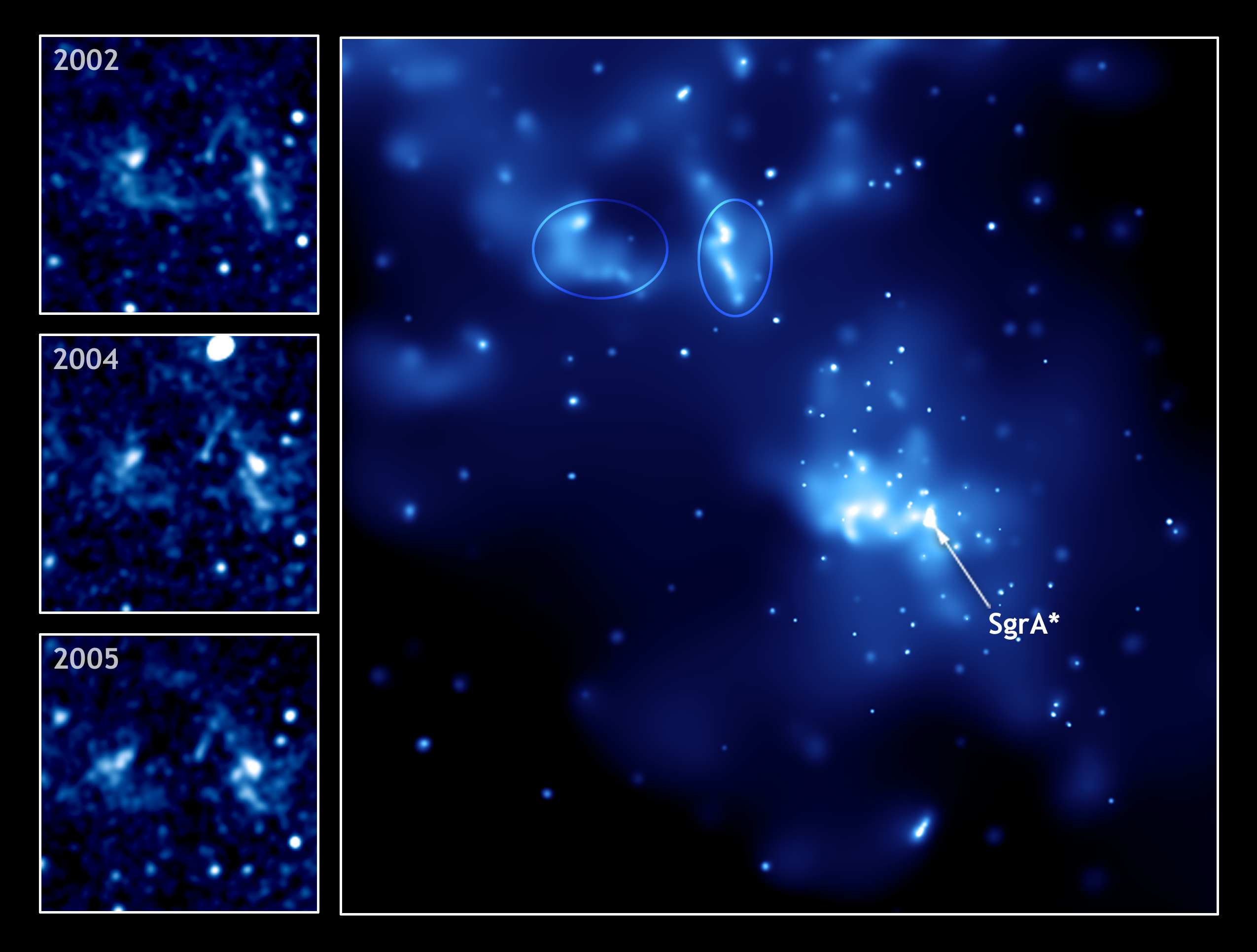
Upon careful observation of the tracks they noticed how the nearby stars were catapulted/accelerated /swung around (using what is appropriately described as slingshot action.aka satellite motion lingo) , as they approached the centre of the galaxy.Their mathematical computations quite interestingly predicted that the mass of matter that would be required to accelerate the giant stars in the way observed, (the mass of the stars was estimated by measuring their brightness and motion), would require mass of the order of approx 3000SM(SM=Solar Mass.Number of times the mass of our own Sun) to be concentrated at the centre of our galaxy.This amazingly large amount of mass concentrated in this realtively small region of space, without being squeezed into oozing out radiation in the form of light oin the optical region led them to only oine conclusion.-THERE WAS A SUPERMASSIVE BLACK HOLE AT OUR CENTRE!

And the rest is (NOT HISTORY!) told only by the future....
Surjodeb Basu (/dev).

ps- in case u wanted to do futher reading up, the exact center is referred to as Sagittarius A.
It consists of three components, the supernova remnant Sagittarius A East , the spiral structure Sagittarius A West, and a very bright compact radio source at the centre of the spiral, Sagittarius A*. These three overlap: Sagittarius A East is the largest, West appears off-center within East, and A* is at the center of West.

U can also refer to,
http://www.mpe.mpg.de/ir/GC/index.php
http://www.astro.ucla.edu/%7Eghezgroup/gc/

I referred also to,
http://www.astro.ucla.edu/~ghez/
http://www.astro.ucla.edu/%7Eghezgroup/gc/people.shtml


I am also enlosing some pictures (from various sources) that shall help illustrate what i explained.:


What is a Full Moon Ring?

FULL MOON RINGS: Sometimes the best thing about a bright full Moon is what goes on around it. Last night in Northern Ireland, Conor McDonald photographed this beautiful moon-ring:

The correct name is "lunar aureole," cousin to the better-known lunar corona. Aureoles and coronas are caused by water droplets in clouds. When the droplets are a jumble of different sizes, they produce a straw-colored ring--an aureole. When the droplets are all of the same size they produce a rainbow-colored ring--a corona. Look for both tonight.
Surjodeb Basu (/dev)

Why is a Mercury Transit so rare and Significant?

Why are transits of Mercury so rare? Does it make sense?
The thing is Mercury's orbit is tipped with respect to Earth's and crosses the plane of our orbit at only two points. For a transit to occur, Mercury must lie near one of those points when it passes us. To meet these conditions, Mercury must slip between Earth and the Sun within 3 days of May 8 or within 5 days of November 10.

The unequal size of these "transit zones" reflects the eccentricity of Mercury's orbit, which gives us twice as many transits in November as in May. Mercury lies farther from the Sun and moves much slower in May, which reduces our chance of catching it in the right place. But Mercury's disk appears 20-percent larger during May transits because it's closer to us then.
Surjodeb Basu (/dev)

Tuesday, March 25, 2008

Get out... n see the sky. AMAZING!

Amazing? Mindblowing?....I really am at a loss 4 words to describe what i see tonight.

Jus returned abt 2 hours back from a trip to Endpoint. rt at the beginning, I'll add that even tho at the beginning when i was abt to type on the blog n started researching to make sure all the stars i saw were actually exactly the ones i thought they were, it was not raining.-but unfortunately the rains started pouring around 3-45... so if u r awake n reading this, i'm really sorry to disappoint u...but lookin at the bright side, the rain appears to be slowing down n u still hav at least 1.5 hrs to go till sunrise.

nyways, i'll continue with a brief description of what exactly it was that drove me hysterical.
I had ended up at EndPoint accidentally as we were testing out a friend's new Bullet.the sky wasn't particularly clear or something.it was what would hav appeared to be an ordinary night in manipal, except 4 the blessings of the Rain gods who decided to spare us after 3 days of constant bombardment. as one would expect, on a dry night after so many showers, the weather was extremely pleasant.-cool & breezy. n hence, we decided to stop at endpoint. what awaited me there was .... -(i don't think i can find the correct adjective).

i'll jus describe what i saw in the most mundane scientific language to contain the unbridled excitement that is driving me mad.- the southern sky.....-it was ALIVE!

it's been 3 yrs that i've been here in Manipal.but in all my yrs here, i've never,(pause) NEVER, seen a southern sky that beautiful.(that bright.that clear.that ....-as i said there r a 1001 adjectives i could think of to describe toNight).

even tho the northern, parts of the eastern, n western sky were oevrcast, the southern sky shone out as if it was a bed of pearls, or a necklace of diamonds.-JUST AMAZING!

i think a number of other factors might hav contributed in makin this possible too.
(i)End point actually looked somewhat like what it did (in terms of light density) when i came here 3yrs back.-the lights at the football field were 4 some reason turned off.
there was also (strangely) absolutely no parked cars, n no bikers drivin to/from there.

(ii)the moon was very very low in the south-eastern horizon. - n boy did it look like a BEAUTY!
(had the southern sky not blown me away, i would hav surely returned infatuated with the moon.)

(iii)pls don laugh, thsi might sound a li'l weird, but i think the fact that the rest of the sky bein overcast might hav helped the southern sky appear far more brighter that it usual would.(note:APPEAR.)

some of the major constellations that i saw: I could see very very clearly Corvus, Canopus(which is a star but is extremely prominent), Scorpius,Spica(vrigo, this region was not that clear tho as it approcahed the central somewhat middle part of the sky),Libra, Sirius, Procyon, n a whole lot of stars( A REALLY REALLY WHOLE LOT.-as in almost like a sea of uniformy distributed stars) in the Lupus,Pyxis, Eridanius region.-now i know why they call it Eridanius!(it really must hav looked like a river from places which hav a clear view of the South as i saw it.).n i thought i could also make out Crux/false cross, but that might be attributable to my imagination working overtime itryin to make sense of the field of stars that was Eridanius.i think the effect(/the prominence of the southern sky, as if it was a sea of sparkling jewels) was made all the more prominent due to the presence of what appeared to me then to be Mars & Saturn.However, i was so dumbstruck by the beauty of the sight i didn't record the locations of those 2 accuaretly in my memory.

all in all, a night(/more accurately, A VIEW) that will be difficult (extremely difficult) to forget.

Surjodeb Basu /dev.

ps- jus when i am abt to press the publish button, i realized.-pity, i didn't hav a camera. the pic shall only liev on in my memory.
(strange part is, until i realized that i'm postin without a pic, it never occured to me that i had made a blunder by not takin a photograph to preserve that view.-it was so deeply etched in my mind! [-that the thought never arose])

Sunday, March 16, 2008

qns: that i was asked

@Deep Impact Dude:
Dude, i couldn't find the original collision sequence image i had created from the Earth & Flyby orbiter videos that i had obtained when the original event took place.but i got some decent stuff from the net.look thru it, n get back to me at my mail or comments page if u hav ny further qns.

ps- sorry dude, got a lil late.-rushed back only now -i know it's a li'l late considerin i had said tonight.but then again it's only 3-30 in the night.would've msgd u/ mailed u as soon as i had posted this, but there was data insufficiency in that aspect.but i hope u'll find this data useful.-reading material can be obtained from a variety of sources. You might also be interested in "EPOXI".(not the resin)


@Milkyway Black Hole dude,

here's ur pic cum proof.


posting Andrea Ghez group's link:
http://www.astro.ucla.edu/~ghezgroup/gc/journey/
(http://www.astro.ucla.edu/~ghez/)
& the Max Planck Institute Group's link....
http://www.mpe.mpg.de/ir/GC/index.php

enjoy.

4 ur pleasure.

Surjodeb Basu


ps- feel free to look at the previous post n brainstorm on that scientific abnormality.
http://arstechnica.com/journals/science.ars/2008/03/04/anomalous-speed-in-space

Wednesday, March 5, 2008

to nyone who can help/brainstorm on the topic:

i jus saw somethin very interestin.(/read)

wonderin what it could possibly be(or at least tryin to hypothesise any reasonable conclusion as to where the fundamental flaw{in the theory} is.[even a hint as to what direction the flaw might be in might be helpful])....

was jus wonderin what ur views on this might be.

take a look if u can:
http://arstechnica.com/journals/science.ars/2008/03/04/anomalous-speed-in-space

if nyone can even remotely shed some light on this, pls get back to me by entering ur comment.

Surjodeb Basu

Wednesday, January 16, 2008

Mercury Revealed

The data sent by the Messenger probe which passed Mercury on Monday has started to arrive at Earth. The pictures revealed some parts of the surface that were earlier missed by the Mariner 10 spacecraft (in the 70s). The probe went as close as 200 km to Mercury. It is expected to get into orbit in another 3 years time.

-Mohit Gidwani

Wednesday, January 9, 2008

Mission Update : Lunar Reconnaissance Orbiter

LRO SpacecraftMission Overview

The Lunar Reconnaissance Orbiter (LRO) is the first mission in NASA's Vision for Space Exploration, a plan to return to the moon and then to travel to Mars and beyond. LRO will launch in late 2008 with the objectives to finding safe landing sites, locate potential resources, characterize the radiation environment, and demonstrate new technology
Read more about it at:
http://lunar.gsfc.nasa.gov/index.html


~Mohit Gidwani

Sunday, January 6, 2008

The apparent truth of the universe-gravitational lensing


“What we see is not the complete truth”, and our universe seems to follow this statement quite naturally. We already know how the presence of the gas envelope around our planet known as the atmosphere distorts and varies the brightness and size of celestial objects under observation by multiple refractions and other optical phenomena like interference. But that’s not all when we study this art of eliminating the illusive and apparent behavior of what we see up there in the sky.

We face another gravitational-optical phenomenon known as gravitational lensing which is capable of varying the brightness and size of a distant celestial object that we might be interested in observing. Gravitational lensing occurs when gravity from a massive object, like a galaxy or a star cluster, warps space time, bending everything in it including the paths followed by light rays from a bright background source. Due to this, a time lapse is observed for the light to reach the observer leading to magnification and distortion of the apparent image of the background source. It is also known as gravitational mirage in the case where there are multiple images for a single source.
In the above image we can see four images of the same distant quasar appears around a foreground galaxy due to strong gravitational lensing.
Since our universe is taken as to be a three spatial dimensional system the gravitational lens does not have a focal point but a focal line. It has also been observed that maximum bending occurs closest to the center of gravitational lens which is opposite to that for an optical lens. Also, gravitational lensing can work on all kinds of electromagnetic radiations and not just visible light.
One of the most interesting observations was made by st. Petersburg physicist Orest Chwolson, he observed that if the source which can act as a huge lensing object, and observer lie in a straight line, the source’s apparent image would be a ring behind the actual source referred to as Einstein ring.

There are three classes of lensing -
1. Strong lensing - which causes visible distortions like in case of Einstein rings and multiple images.
2. Weak lensing - which causes very minute distortions of low degree.
3. Micro lensing - which leads to only brightness variations and no distortions.
A gravitational lens acts like a huge telescope that makes faint objects appear brighter and larger. This makes the study of distant objects comparatively easy.
When someone really wants something with all his heart the entire universe conspires in favor of it…guess it is very well doing so for the researchers all this while.
-kuhu shukla
References:
1. Wikipedia.com
2. Nasa.gov

Saturday, December 22, 2007

Strange Weather in space.-The discovery of Ion Plumes.

Something abnormal is disturbing the electrical equilibrium in the Atmospheric Space(the Ionosphere to be specific) above Africa of late. Just last week scientists from around the world gathered together at Addis Ababa(the capital of Ethiopia) to discuss what could be doing this.-(This was called the “Africa Space Weather Workshop, November 12th 2007,” organized primarily under the auspices of the International Heliophysical Year,2007, which is being organized symbolically on the Golden Jubilee of the International Geophysical Year,1957).


They ended up with a proper name for this strange phenomenon they had seen of late.-They called it an Ion Plume!


This strange new phenomenon that we have now begun to call an ion plume is basically a newly discovered form of space weather. The plumes are somewhat like smoke billowing out of a factory smokestack—except instead of ordinary ash and dust, ion plumes are made of electrified gas (or actually better decribed as IONIZED gas, to maintain the lingo) floating so high above the ground that they come in contact with space itself.They appear during geomagnetic storms (basically Coronal bursts or CMEs as we otherwise call them) and they can interfere with satellite transmissions, airline navigation and radio communications, i.e. to say basically any mode of transmission where the accuracy of the information/data that is being encoded in electromagnetic waves is being made use of.

These Ion plumes that we are intending to monitor(listen in on & subsequently track) using receivers(generally GPS is used) inhabit a layer of the Earth's atmosphere called the Ionosphere, a broad region extending from 85 km to 600 km above ground level to outer Space, where ultraviolet radiation from the sun knocks electrons off atoms and molecules, creating a layer of ionized gas or plasma surrounding our entire planet. As ham(amateur radio relay) radio operators have known for nearly a century, the ionosphere can bend, distort, reflect and even absorb radio waves. Plumes amplify these effects.Thus exhibiting characteristics that allow for their detection.


These plumes were basically first detected due to the effect they produced on GPS signals.This led to their discovery not too long back.– couple of years to be precise as GPS was not in widespread civilian use before that.
As one would expect, due to the abundance of GPS receivers in the North American continent, this was where they were first detected.


But now, if you notice carefully, there is still something critical missing in my description of this Plume phenomenon in my post.-While I gave the analogy of smoke billowing out of a smokestack, I have still not been able to give you a description of the smokestack.In other words, you've seen the smoke, but where is the smokestack that I referred to previously?-The search to explain this anomaly, that has not yet been completely explained even by the scientists, is leading a whole lot of scientists to Africa.-As I mentioned before, this weird form of space weather that was unknown to us before has been observed in abundance of late over the continental landmass of Africa.

Now as it turns out, most of the scientists who have been working on this have now begun to believe that the source of the plumes is near the Earth's magnetic equator.This includes one particularly interesting Bengali girl from Calcutta,India whose research work summary on the subject I directly looked through while preparing my post.She is NASA heliophysicist Lika Guhathakurta (otherwise also called “Madhulika” affectionately by those in the astronomy community).(who is also attending the Workshop I previously described).When asked, why Africa?, she quite frankly explains to everyone that Africa is a great place to check this possibility(the theory of origin of the plumes at the Earth’s magnetic Equator) because the magnetic equator passes directly over the sub-Sahara.But there is a problem of practicality in doing this as there are just not enough sensors in Africa to study this phenomenon. -The sensor of choice is, as indicated by experience from incidents that took place before, the dual-frequency GPS receiver.However, unlike their wealthier counterparts in North America, the Africans have only a few dozen dual frequency GPS receivers in comparison to the thousands of them presently in use in the US alone.And fewer still in sub Saharan Africa. It would not be stretching it too far to say that the purpose of the abovementioned workshop itself was to familiarize the African space scientists with this plume phenomenon and thus encourage them to do the groundwork for a continent-wide GPS network in the hopes of deploying hundreds of thousands of receivers in sub-Saharan Africa in the years to come.(In other words, engineer a revolution in GPS receiver usage in Africa.)

Presently only North America is equipped enough to have a well-mapped Ionosphere in realtime (note:when we say realtime here, we mean = “live”).The NOAA(National Oceanographic and Atmospheric Administration) posts new images every quarter of an hour at their website at http://www.swpc.noaa.gov/ustec . However, the organizers of the workshop have set an aim for themselves that in the next five years they too shall begin making such realtime maps of the ionosphere over Africa.

Now having explained how Africa fits into the bigger picture if you were to begin to wonder why does it have to be Africa only where we have to observe this phenomenon?(because Africa itself has barely any infrastructure for research and observation on this scale!).Why not just wait for the next Ion Plume over a somewhat more wealthier region of the world which might also be on the magnetic equator?! i.e. if you were to wonder, just how important Africa is to the study of this phenomenon.

Then all you have to do is consider the list of organizations who have joined forces to sponsor the Africa Space Weather Workshop: NASA, the NOAA, the National Science Foundation(NSF), the European Office of Aerospace Research and Development (EOARD), the International Center for Theoretical Physics (ICTP), and many others.It is widely understood(or better said, Accepted,) that Africa is the key to the puzzle as it is the only place of it’s sort located so perfectly on the Magnetic Equator. Therein lies the dilemma so beautifully poised to us by Mother Nature.

Thus as it turns out Africa is “plasma incognita” as of now.

But it shall not be so for too long. Stay tuned!(specially all the HAMs!)

Surjodeb Basu .(/Dev/Dave)
(22/11/2007)


I am attaching here a picture of a typical example of an Ion Plume.This is the plume of Nov. 20, 2003:(It was observed over North America.-I hav attached the whole description below)

My Description of the above photo: A plume of excess electron density that was observed over North America on Nov. 20, 2003.The plume was discovered and mapped by its effect on GPS signals alone.I got this image from the NASA archives, courtesy of Anthea Coster and John Foster of MIT.

Two days before this map was made, an explosion on the sun had hurled a cloud of magnetized gas—a CME—towards Earth.The plume formed when the CME hit, triggering a strong geomagnetic storm.The plume consisted of ionized air at high altitude moving from Florida to Canada at a speed of 1 km/s (that would be aprrox 2200 mph).

Pls note: 4 this article i hav used as my src reference material that was mostly in the form of Press Releases by the IHY organisation.Any other data that i needed i researched by obtaining from the internet any interviews of people associated with IHY(Mostly NASA people).

ps-the author would like to acknowledge that the writing of this article was inspired largely due to the association of Prof.Madhulika Guhathakurta with research into this new discovery.

Friday, December 21, 2007


was at this end of exam bonfire last night at a friends place.pretty good food and all.but the good part was up there.even thru the lights and the traffic haunted delhi sky i could see a pretty decent part of the sky.well the first thng i noticed was mars..its close and really bright.well i know a lot of people have told u that before but really,if u haven't paid attention now.please do.especially if u have a decent pair of binoculars.well one of the reasons i'm eating up ur head is that mars won't appear this big for the next 16 years.

well there are a lot of other things u can do with this..well u can learn about planetary moton for one by noticing which stars are close to mars every night.u can find mars via The Full Moon On December 23, the Moon sits just 1° from the planet (one degree is equal to 2 Moon-diameters). Observers can also track Mars' westward motion against the stars of Geministars of Gemini.as shown in the pic above..
well do get ur shot at it kyounki kisko pata ka ho naa ho