explore the universe!AMAZING TOOL by microsoft..
Monday, May 19, 2008


Monday, April 21, 2008
those BALLS OF FIRE are back
it's that time of the year again.And it's time for yet another display of those spectacular Leonid showers.These meteor showers(seen basically as streaks of light), and if large enough sometimes individually described as shooting stars, are basically a display of atmospheric fireworks.They are basically caused by rocky remnants left on the orbital path of earth by some other astronomical objects such as comets burning up upon encountering the earthly atmosphere.Leonids are so called as they originate ( that is enter the Earth's atmosphere) in the area of the sky demarcated by the constellation of Leo.Due to the regularity of Earth's orbital period and path, these showers (in particular, in the month of November) are caused almost always by the comet described by the name Comet 55P, Tempel-Tuttle.Thus as one would conjecture they are most prominent when the comet has just visited it's perihelion(that is it's closest approach to the Sun.),- as this would be the time that most of the cometary debris would be floating closely packed in interplanetary circumsolar space.
As the comet has not been in close proximity to the Sun for quite some time, the 2007 Leonids are expected to be a somewhat modest spectacle in comparison to the previous season's fiery display.but they are still expected to be quite a sight nonetheless.the showers peaked this last week and are still visible to the keen observer.all one requires is a comfortable place to lie down somewhere below the open sky.keeping an uninterrupted view of the whole sky while lying down is essential to the act of catching a meteor(/shooting star) doing the burning ('Great Balls of Fire') act.Binoculars are a strict no-no, as are telescopes, as this would narrow the field of observation and greatly reduce the observer's capability to spot a shooting star and also make it difficult for the observer to track it once he spots it(if he succeeds at all in spotting it using binoculars in the first place!).
as described before, focus on the constellation of Leo from where these shooting stars shall appear to streak out.do note that the shooting stars shall only appear to be streaking out from Leo and might make their brightness more apparent once they are further away from the constellation.Hence it is essential to keep a look at that entire region of sky(and not limit oneself to Leo alone) to have a proper perspective of the showers.If you have trouble locating Leo, but are comfortable identifying the planets, Leo is the (abnormally big bladed) sickle shaped constellation appearing above Saturn.
so i guess things are looking up this week, and maybe we should too.....
Surjodeb Basu (/Dev).
Some amazing images of actual Leonids in action in different parts of the world taken with different camera exposures:
(Click on them to enlarge)


the black hole in our midst
holes are generally black (or so we conjectured!).but what if the best way to detect a hole was by the brightness surrounding it?!
Such is the story of our nearest black hole.
We know that all holes in space attract.but black holes are special! These holes warp space (into holes) to such an extent that their attraction is the strongest possible.Not even light itself can escape their lure.
In the past most people used to think that Black Holes were rare objects, to be found in remote regions of the cosmos.But during the nights in the first week of November in 2004, a team of astronomers from UCLA (led by Andrea Ghez) and another team from the Max Planck Institute(led by Reinhard Genzel & Rainer Schodel) observed the supposed center of our galaxy in Sagittarius using simultaneously the Keck telescope in Hawaii and the ESO's Very Large Telescope in Chile.
Before this, The astronomical observations in the Radio spectrum had indicated that due to maximum intensity of radiation in that region in the sky, that was probably the centre of our galaxy.
We derive this conclusion logically from the facts derived and then proven by observation, based on the assumption that no ExtraGalactic source could produce a cumulative effect on radiation intensity of such a magnitude(on us) that it would overshadow the cumulative effect of radiation produced inside the galaxy.the second assumption we make in our search is that as we face the center of the galaxy we will encounter light at maximum intensity(this is because if one draws a circle and from any point inside the circle he wants to draw the longest line, it has to pass through the centre and towards the other side.this is analogous to saying, "to encounter the maximum number of stars[or in this case light], we must face the centre of our galaxy".)
knowing these two things we can them conclude that probably the light from the direction of the centre of the galaxy has to travel through the maximum number of obstacles to reach us.this then leads us to the next conclusion that obviously then efforts to search for this direction in the visible spectrum would be futile.
hence we attempt our search in the longest wavelength regions i.e. in the radio spectrum.
now, as i was saying, that week in november these 2 teams from the 2 universities upon having already previously been intimated with Harlow Shapley's work on this subject (that was done around 1918) set out observing the Centre of the Galaxy.As they had expected, brightness was at it's peak.A large number of massive stars appeared to rotate around that place.But the peculiarity of the observation was that there appeared to be nothing bright (or no BIG BRIGHT STAR) at what appeared at high resolutions, to be the exact centre of our galaxy (as everything else appeared to be rotating around it.) This was an observation that went against what one would instinctively assume to be true.and most of the members of the 2 teams were not quite happy with this observation
Something felt out of place!
The two teams, in particular the team led by Prof.Andrea Ghez from UCLA decided it best to observe this region over a period of time. and try and decide by the motion of the nearby stars around the centre, the estimated gravitational pull that would be required from the centre of the galaxy such that the nearby stars might revolve in the way they revolve around the centre.
Upon careful observation of the tracks they noticed how the nearby stars were catapulted/accelerated /swung around (using what is appropriately described as slingshot action.aka satellite motion lingo) , as they approached the centre of the galaxy.Their mathematical computations quite interestingly predicted that the mass of matter that would be required to accelerate the giant stars in the way observed, (the mass of the stars was estimated by measuring their brightness and motion), would require mass of the order of approx 3000SM(SM=Solar Mass.Number of times the mass of our own Sun) to be concentrated at the centre of our galaxy.This amazingly large amount of mass concentrated in this realtively small region of space, without being squeezed into oozing out radiation in the form of light oin the optical region led them to only oine conclusion.-THERE WAS A SUPERMASSIVE BLACK HOLE AT OUR CENTRE!
And the rest is (NOT HISTORY!) told only by the future....
Surjodeb Basu (/dev).
ps- in case u wanted to do futher reading up, the exact center is referred to as Sagittarius A.
It consists of three components, the supernova remnant Sagittarius A East , the spiral structure Sagittarius A West, and a very bright compact radio source at the centre of the spiral, Sagittarius A*. These three overlap: Sagittarius A East is the largest, West appears off-center within East, and A* is at the center of West.
U can also refer to,
http://www.mpe.mpg.de/ir/GC/index.php
http://www.astro.ucla.edu/%7Eghezgroup/gc/
I referred also to,
http://www.astro.ucla.edu/~ghez/
http://www.astro.ucla.edu/%7Eghezgroup/gc/people.shtml
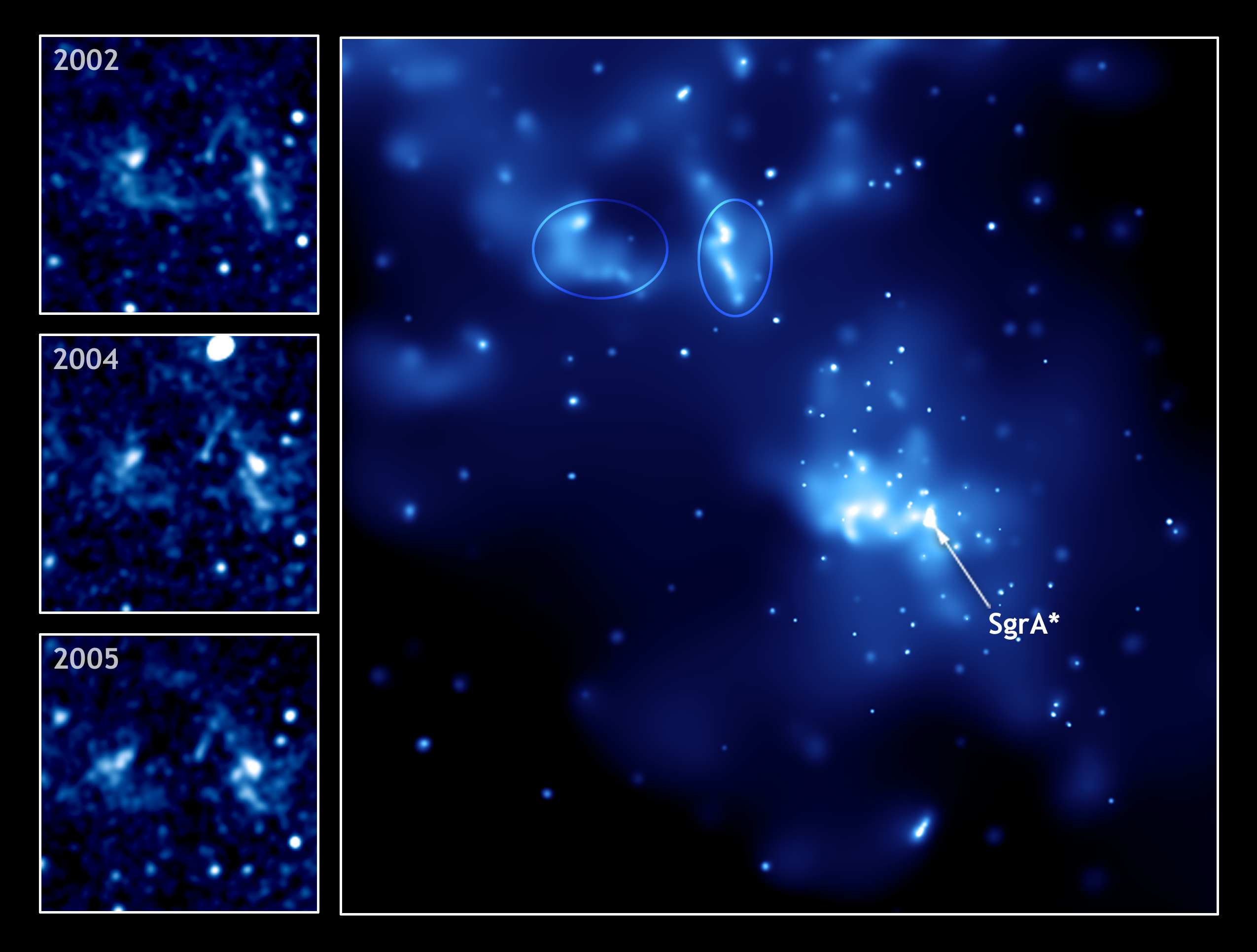
I am also enlosing some pictures (from various sources) that shall help illustrate what i explained.:


Such is the story of our nearest black hole.
We know that all holes in space attract.but black holes are special! These holes warp space (into holes) to such an extent that their attraction is the strongest possible.Not even light itself can escape their lure.
In the past most people used to think that Black Holes were rare objects, to be found in remote regions of the cosmos.But during the nights in the first week of November in 2004, a team of astronomers from UCLA (led by Andrea Ghez) and another team from the Max Planck Institute(led by Reinhard Genzel & Rainer Schodel) observed the supposed center of our galaxy in Sagittarius using simultaneously the Keck telescope in Hawaii and the ESO's Very Large Telescope in Chile.
Before this, The astronomical observations in the Radio spectrum had indicated that due to maximum intensity of radiation in that region in the sky, that was probably the centre of our galaxy.
We derive this conclusion logically from the facts derived and then proven by observation, based on the assumption that no ExtraGalactic source could produce a cumulative effect on radiation intensity of such a magnitude(on us) that it would overshadow the cumulative effect of radiation produced inside the galaxy.the second assumption we make in our search is that as we face the center of the galaxy we will encounter light at maximum intensity(this is because if one draws a circle and from any point inside the circle he wants to draw the longest line, it has to pass through the centre and towards the other side.this is analogous to saying, "to encounter the maximum number of stars[or in this case light], we must face the centre of our galaxy".)
knowing these two things we can them conclude that probably the light from the direction of the centre of the galaxy has to travel through the maximum number of obstacles to reach us.this then leads us to the next conclusion that obviously then efforts to search for this direction in the visible spectrum would be futile.
hence we attempt our search in the longest wavelength regions i.e. in the radio spectrum.
now, as i was saying, that week in november these 2 teams from the 2 universities upon having already previously been intimated with Harlow Shapley's work on this subject (that was done around 1918) set out observing the Centre of the Galaxy.As they had expected, brightness was at it's peak.A large number of massive stars appeared to rotate around that place.But the peculiarity of the observation was that there appeared to be nothing bright (or no BIG BRIGHT STAR) at what appeared at high resolutions, to be the exact centre of our galaxy (as everything else appeared to be rotating around it.) This was an observation that went against what one would instinctively assume to be true.and most of the members of the 2 teams were not quite happy with this observation
Something felt out of place!
The two teams, in particular the team led by Prof.Andrea Ghez from UCLA decided it best to observe this region over a period of time. and try and decide by the motion of the nearby stars around the centre, the estimated gravitational pull that would be required from the centre of the galaxy such that the nearby stars might revolve in the way they revolve around the centre.
Upon careful observation of the tracks they noticed how the nearby stars were catapulted/accelerated /swung around (using what is appropriately described as slingshot action.aka satellite motion lingo) , as they approached the centre of the galaxy.Their mathematical computations quite interestingly predicted that the mass of matter that would be required to accelerate the giant stars in the way observed, (the mass of the stars was estimated by measuring their brightness and motion), would require mass of the order of approx 3000SM(SM=Solar Mass.Number of times the mass of our own Sun) to be concentrated at the centre of our galaxy.This amazingly large amount of mass concentrated in this realtively small region of space, without being squeezed into oozing out radiation in the form of light oin the optical region led them to only oine conclusion.-THERE WAS A SUPERMASSIVE BLACK HOLE AT OUR CENTRE!
And the rest is (NOT HISTORY!) told only by the future....
Surjodeb Basu (/dev).
ps- in case u wanted to do futher reading up, the exact center is referred to as Sagittarius A.
It consists of three components, the supernova remnant Sagittarius A East , the spiral structure Sagittarius A West, and a very bright compact radio source at the centre of the spiral, Sagittarius A*. These three overlap: Sagittarius A East is the largest, West appears off-center within East, and A* is at the center of West.
U can also refer to,
http://www.mpe.mpg.de/ir/GC
http://www.astro.ucla.edu/
I referred also to,
http://www.astro.ucla.edu/
http://www.astro.ucla.edu/
I am also enlosing some pictures (from various sources) that shall help illustrate what i explained.:




What is a Full Moon Ring?
FULL MOON RINGS: Sometimes the best thing about a bright full Moon is what goes on around it. Last night in Northern Ireland, Conor McDonald photographed this beautiful moon-ring:

The correct name is "lunar aureole," cousin to the better-known lunar corona. Aureoles and coronas are caused by water droplets in clouds. When the droplets are a jumble of different sizes, they produce a straw-colored ring--an aureole. When the droplets are all of the same size they produce a rainbow-colored ring--a corona. Look for both tonight.
Surjodeb Basu (/dev)
Surjodeb Basu (/dev)

Why is a Mercury Transit so rare and Significant?
Why are transits of Mercury so rare? Does it make sense?
The thing is Mercury's orbit is tipped with respect to Earth's and crosses the plane of our orbit at only two points. For a transit to occur, Mercury must lie near one of those points when it passes us. To meet these conditions, Mercury must slip between Earth and the Sun within 3 days of May 8 or within 5 days of November 10.
The unequal size of these "transit zones" reflects the eccentricity of Mercury's orbit, which gives us twice as many transits in November as in May. Mercury lies farther from the Sun and moves much slower in May, which reduces our chance of catching it in the right place. But Mercury's disk appears 20-percent larger during May transits because it's closer to us then.
Surjodeb Basu (/dev)

Tuesday, March 25, 2008
Get out... n see the sky. AMAZING!
Amazing? Mindblowing?....I really am at a loss 4 words to describe what i see tonight.
Jus returned abt 2 hours back from a trip to Endpoint. rt at the beginning, I'll add that even tho at the beginning when i was abt to type on the blog n started researching to make sure all the stars i saw were actually exactly the ones i thought they were, it was not raining.-but unfortunately the rains started pouring around 3-45... so if u r awake n reading this, i'm really sorry to disappoint u...but lookin at the bright side, the rain appears to be slowing down n u still hav at least 1.5 hrs to go till sunrise.
nyways, i'll continue with a brief description of what exactly it was that drove me hysterical.
I had ended up at EndPoint accidentally as we were testing out a friend's new Bullet.the sky wasn't particularly clear or something.it was what would hav appeared to be an ordinary night in manipal, except 4 the blessings of the Rain gods who decided to spare us after 3 days of constant bombardment. as one would expect, on a dry night after so many showers, the weather was extremely pleasant.-cool & breezy. n hence, we decided to stop at endpoint. what awaited me there was .... -(i don't think i can find the correct adjective).
i'll jus describe what i saw in the most mundane scientific language to contain the unbridled excitement that is driving me mad.- the southern sky.....-it was ALIVE!
it's been 3 yrs that i've been here in Manipal.but in all my yrs here, i've never,(pause) NEVER, seen a southern sky that beautiful.(that bright.that clear.that ....-as i said there r a 1001 adjectives i could think of to describe toNight).
even tho the northern, parts of the eastern, n western sky were oevrcast, the southern sky shone out as if it was a bed of pearls, or a necklace of diamonds.-JUST AMAZING!
i think a number of other factors might hav contributed in makin this possible too.
(i)End point actually looked somewhat like what it did (in terms of light density) when i came here 3yrs back.-the lights at the football field were 4 some reason turned off.
there was also (strangely) absolutely no parked cars, n no bikers drivin to/from there.
(ii)the moon was very very low in the south-eastern horizon. - n boy did it look like a BEAUTY!
(had the southern sky not blown me away, i would hav surely returned infatuated with the moon.)
(iii)pls don laugh, thsi might sound a li'l weird, but i think the fact that the rest of the sky bein overcast might hav helped the southern sky appear far more brighter that it usual would.(note:APPEAR.)
some of the major constellations that i saw: I could see very very clearly Corvus, Canopus(which is a star but is extremely prominent), Scorpius,Spica(vrigo, this region was not that clear tho as it approcahed the central somewhat middle part of the sky),Libra, Sirius, Procyon, n a whole lot of stars( A REALLY REALLY WHOLE LOT.-as in almost like a sea of uniformy distributed stars) in the Lupus,Pyxis, Eridanius region.-now i know why they call it Eridanius!(it really must hav looked like a river from places which hav a clear view of the South as i saw it.).n i thought i could also make out Crux/false cross, but that might be attributable to my imagination working overtime itryin to make sense of the field of stars that was Eridanius.i think the effect(/the prominence of the southern sky, as if it was a sea of sparkling jewels) was made all the more prominent due to the presence of what appeared to me then to be Mars & Saturn.However, i was so dumbstruck by the beauty of the sight i didn't record the locations of those 2 accuaretly in my memory.
all in all, a night(/more accurately, A VIEW) that will be difficult (extremely difficult) to forget.
Surjodeb Basu /dev.
ps- jus when i am abt to press the publish button, i realized.-pity, i didn't hav a camera. the pic shall only liev on in my memory.
(strange part is, until i realized that i'm postin without a pic, it never occured to me that i had made a blunder by not takin a photograph to preserve that view.-it was so deeply etched in my mind! [-that the thought never arose])
Sunday, March 16, 2008
qns: that i was asked
@Deep Impact Dude:
Dude, i couldn't find the original collision sequence image i had created from the Earth & Flyby orbiter videos that i had obtained when the original event took place.but i got some decent stuff from the net.look thru it, n get back to me at my mail or comments page if u hav ny further qns.


@Milkyway Black Hole dude,

posting Andrea Ghez group's link:
http://www.astro.ucla.edu/~ghezgroup/gc/journey/
(http://www.astro.ucla.edu/~ghez/)
& the Max Planck Institute Group's link....
http://www.mpe.mpg.de/ir/GC/index.php
enjoy.
4 ur pleasure.
Surjodeb Basu
ps- feel free to look at the previous post n brainstorm on that scientific abnormality.
http://arstechnica.com/journals/science.ars/2008/03/04/anomalous-speed-in-space
Dude, i couldn't find the original collision sequence image i had created from the Earth & Flyby orbiter videos that i had obtained when the original event took place.but i got some decent stuff from the net.look thru it, n get back to me at my mail or comments page if u hav ny further qns.
ps- sorry dude, got a lil late.-rushed back only now -i know it's a li'l late considerin i had said tonight.but then again it's only 3-30 in the night.would've msgd u/ mailed u as soon as i had posted this, but there was data insufficiency in that aspect.but i hope u'll find this data useful.-reading material can be obtained from a variety of sources. You might also be interested in "EPOXI".(not the resin)


@Milkyway Black Hole dude,
here's ur pic cum proof.

posting Andrea Ghez group's link:
http://www.astro.ucla.edu/~ghezgroup/gc/journey/
(http://www.astro.ucla.edu/~ghez/)
& the Max Planck Institute Group's link....
http://www.mpe.mpg.de/ir/GC/index.php
enjoy.
4 ur pleasure.
Surjodeb Basu
ps- feel free to look at the previous post n brainstorm on that scientific abnormality.
http://arstechnica.com/journals/science.ars/2008/03/04/anomalous-speed-in-space
Subscribe to:
Posts (Atom)
